Corporate Housing vs Traditional Hotel: The Real Difference
A comprehensive comparison of corporate housing and traditional hotels — space, cost, amenities, and why corporate housing wins for stays longer than two weeks.
Invested Escapes
Temporary Housing Experts
If you're booking lodging for a business trip, relocation, or extended assignment, the default choice is usually a hotel. It's familiar, easy to book, and feels like the safe option. But for stays longer than a couple of weeks, corporate housing — a fully furnished residential property rented on monthly terms — offers a fundamentally different and better experience. This guide compares corporate housing versus traditional hotels head-to-head, so you can see exactly what you're trading (and gaining) by choosing one over the other.
What Is Corporate Housing?
Corporate housing is a fully furnished residential property — a house, condo, or apartment — rented on monthly terms (30+ days) with all furniture, kitchenware, linens, utilities, internet, and amenities included in a single monthly rate. It's sourced through corporate housing providers like Invested Escapes, who handle matching, placement, and ongoing coordination. Properties are located in residential neighborhoods and offer a genuine home environment with a full kitchen, private bedrooms, in-unit laundry, smart TVs, dedicated workspaces, and outdoor amenities like grills, garages, fencing, and backyards.
What Is a Traditional Hotel?
A traditional hotel is a commercial lodging property offering individual rooms (typically 200-400 sq ft) with a bed, bathroom, and basic furnishings. Hotels are designed for short stays (1-7 nights) and operate on a nightly rate model. Amenities may include a restaurant, room service, fitness center, pool, business center, and daily housekeeping. Hotel rooms do not include a kitchen, in-unit laundry, separate living areas, or private outdoor space.
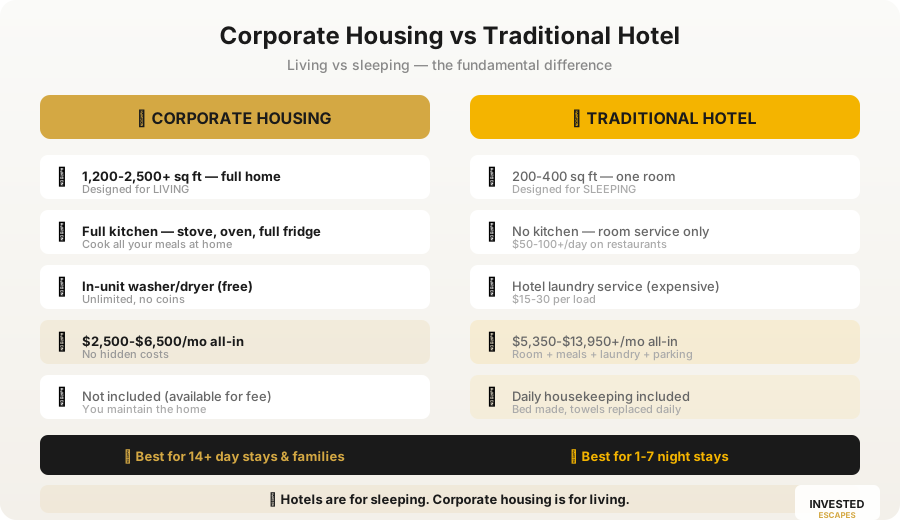
The Core Differences
| Feature | Corporate Housing | Traditional Hotel |
|---|---|---|
| 🏠 🏠 Property Type | Full house, condo, or apartment | Single hotel room (200-400 sq ft) |
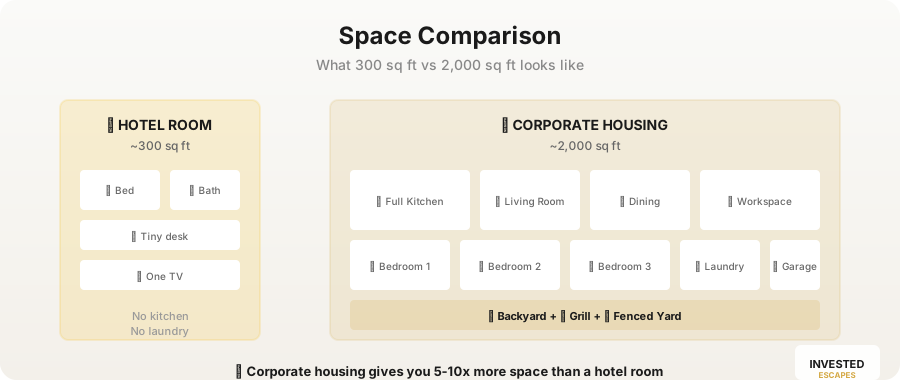
| 🏠 📐 Space | 1,200-2,500+ sq ft | 200-400 sq ft |
| 🎯 🎯 Designed For | 30+ day stays — living, not just sleeping | 1-7 night stays — sleeping, not living |
| 🍳 🍳 Kitchen | Full kitchen with stove, oven, full-size fridge, dishwasher, cookware | No kitchen — room service or restaurant only |
| 🛏 🛏 Bedrooms | Private bedrooms for each person | One room — bed + bathroom |
| 🧺 🧺 Laundry | In-unit washer and dryer (free) | Hotel laundry service (expensive) or none |
| 📺 📺 Smart TV | Smart TVs in living area and bedrooms — your profiles | One hotel TV with limited cable |
| 🏠 💻 Workspace | Dedicated desk and ergonomic chair | Tiny desk or none — often working from bed |
| 🌳 🌳 Backyard | Private backyard — outdoor space | No outdoor space |
| 🔥 Grill | Gas or charcoal grill | No grill — hotel restaurant only |
| 🚗 🚗 Parking | Garage or dedicated driveway | Hotel parking lot — may charge $15-40/night |
| 🔒 🔒 Fencing | Fenced yard for privacy | No privacy — shared building, hallways, walls |
| ⚡ ⚡ Utilities | All included in monthly rate | Included (but internet is often slow/shared) |
| 📋 📋 Lease Terms | Monthly lease (30+ day minimum) | Nightly — flexible check-in/out |
| 💰 💰 Pricing | $2,500-$6,500/month (all-inclusive) | $100-$300+/night = $3,000-$9,000+/month |
| 🧹 Housekeeping | Not included (available for fee) | Daily housekeeping included |
| 🍽 Meals | Cook at home — normal grocery costs | Restaurant/room service — $50-100+/day extra |
| 🐕 🐕 Pets | Pet-friendly, including large dogs | Most don't accept pets or charge daily fees |
| 💬 💬 Support | Dedicated housing coordinator | 24/7 front desk (rotating staff) |
| 🏘 Location | Residential neighborhood | Commercial district / downtown / airport |
The fundamental difference: A hotel room is designed for sleeping. Corporate housing is designed for living. A hotel gives you 300 sq ft and a bed. Corporate housing gives you 2,000 sq ft, a full kitchen, private bedrooms, a backyard, a workspace, and a real neighborhood — often for less money per month.
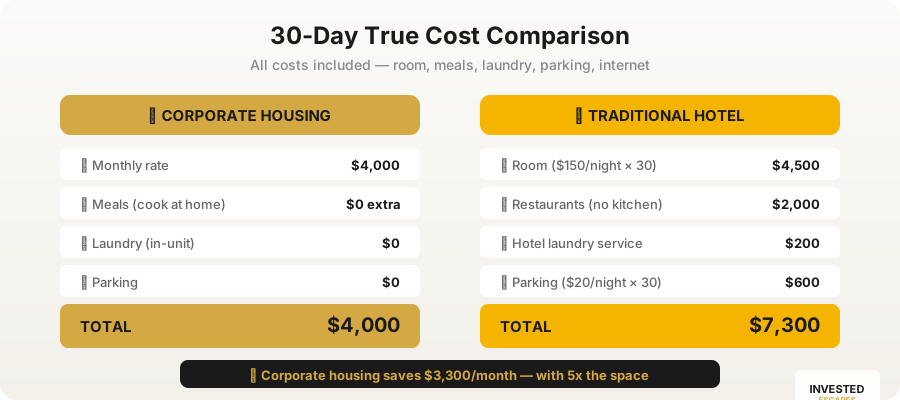
Cost Comparison: The Full Picture
A traditional hotel at $150/night sounds like $4,500/month. But that's just the room — you also need to eat, do laundry, park, and connect to the internet. Here's the real monthly cost comparison:
Traditional Hotel — True Monthly Cost
- 🏨 Room: $100-$300/night = $3,000-$9,000/month
- 🍽 Meals: No kitchen means restaurant for every meal — $50-100+/day = $1,500-$3,000/month
- 🧺 Laundry: Hotel laundry service $15-30/load or dry cleaning — $100-300/month
- 🅿 Parking: $15-40/night in many cities — $450-$1,200/month
- 📶 Internet: Often $10-15/night for "premium" WiFi — $300-450/month
- 📊 Total: $5,350-$13,950+/month all-in
Corporate Housing — True Monthly Cost
- 🏠 Monthly rate: $2,500-$6,500/month (all-inclusive)
- 🍳 Meals: Cook at home — your normal grocery spending, $0 extra
- 🧺 Laundry: Free in-unit washer and dryer
- 🅿 Parking: Garage or driveway included
- 📶 Internet: High-speed residential internet included
- 📊 Total: $2,500-$6,500/month — that's the full cost
For a 30-day stay, corporate housing can save $3,000-$7,000+ compared to a traditional hotel — while giving you 5-10x more space, a full kitchen, private bedrooms, in-unit laundry, and a real home environment. The longer you stay, the bigger the savings.
When a Traditional Hotel Makes Sense
- ⏱ 1-7 night stays: For short business trips, a hotel is the right tool — easy booking, daily housekeeping, central location
- 🧹 Daily housekeeping matters: If you want your bed made and room cleaned every day, hotels include this
- 🗺 Downtown/airport location: If you need to be walking distance from a convention center, financial district, or airport, hotels are better located
- 🏊 Hotel amenities: If you specifically want a pool, spa, room service, or concierge
- 🔄 Total flexibility: If you might check out tomorrow or extend by a night, hotels offer this flexibility
- 💼 Expensed short trips: If your company is paying and it's under a week, the convenience of a hotel wins
When Corporate Housing Is the Clear Winner
- 📅 14+ day stays: After two weeks, hotel fatigue is real — you need a home, not a room
- 👨👩👧👦 Families: Kids need space, separate bedrooms, a yard, and normal routine — a hotel room is not sustainable
- 🍳 You want to cook: A full kitchen means real meals, healthier eating, and huge savings
- 💻 Remote work: A dedicated workspace with reliable internet is essential — not a tiny hotel desk and slow WiFi
- 🐕 Pets: Large dogs, multiple pets — hotels can't accommodate this, corporate housing can
- 🏢 Corporate relocation: Direct invoicing, dedicated coordinator, professional standards — hotels can't match this
- 🔥 Insurance displacement: ALE coverage pays for corporate housing with direct billing — hotels require you to front the money
- 💰 Budget optimization: For stays of 2+ weeks, corporate housing is significantly cheaper when you factor in meals, laundry, and parking
- 🔒 Privacy and quiet: No shared walls, no hallway noise, no elevator traffic — a real home
The Psychological Difference: Living vs Sleeping
The difference between a hotel and corporate housing isn't just physical — it's psychological. A hotel room is a place to sleep. After two weeks, sleeping in the same room you work, eat, and watch TV in creates what psychologists call "hotel fatigue" — a combination of claustrophobia, disrupted routine, and reduced well-being.
Corporate housing gives you separate spaces for separate activities: a kitchen for cooking, a dining table for eating, a living room for relaxing, a bedroom for sleeping, and a workspace for working. This separation is how humans are wired to live — and it matters even more during stressful transitions like relocation or displacement.
Studies show that people living in home-like environments during extended travel experience less stress, better sleep, improved productivity, and faster emotional recovery than those in hotel rooms. The environment you live in during a transition directly impacts your well-being and performance.
The Bottom Line
Traditional hotels and corporate housing serve different purposes. Hotels are optimized for short stays (1-7 nights) where convenience, location, and daily housekeeping matter most. Corporate housing is optimized for longer stays (2+ weeks) where space, cost, a full kitchen, privacy, and a real home environment matter most. If you're staying longer than two weeks — especially with a family, pets, or a need to cook and work — corporate housing is almost always the better choice. For more, see our guides on corporate housing by owner and corporate housing vs extended stay.
For more comparisons, see our complete temporary housing guide and our corporate housing by owner guide. For insurance-related housing, see our insurance housing guide.
Need Corporate Housing Instead of a Hotel?
Tell us about your stay — location, dates, bedrooms, pets — and we'll match you with a furnished home that gives you 5x the space at a better value. Typically responds within 24 hours.
Frequently Asked Questions
What is the main difference between corporate housing and a hotel?
Space and purpose. A traditional hotel gives you a 200-400 sq ft room with a bed and bathroom — designed for sleeping. Corporate housing gives you a 1,200-2,500+ sq ft fully furnished home with a full kitchen, private bedrooms, in-unit laundry, smart TVs, workspace, backyard, grill, and garage — designed for living. Hotels are best for 1-7 night stays; corporate housing is best for stays of 2+ weeks.
Is corporate housing cheaper than a hotel?
For stays of 2+ weeks, corporate housing is significantly cheaper. A hotel at $150/night costs $4,500/month in room rate alone, plus $1,500-3,000 in restaurant meals, $100-300 in laundry, and $300-1,200 in parking — totaling $6,000-$9,000+/month. Corporate housing at $3,500-$5,000/month includes everything — meals cooked at home, free laundry, included parking. The savings grow the longer you stay.
Can I cook meals in corporate housing?
Yes. Corporate housing includes a full kitchen with a stove, oven, full-size refrigerator, dishwasher, and all necessary cookware, dishware, and utensils. You can cook complete meals — unlike a hotel room, which has no kitchen at all. This is one of the biggest advantages of corporate housing, both for healthier eating and significant cost savings.
Does corporate housing have daily housekeeping?
No. Corporate housing does not include daily housekeeping (it's available for an additional fee at some properties). This is one advantage hotels have — daily bed-making, towel replacement, and room cleaning. However, corporate housing includes a full kitchen, in-unit laundry, and 5-10x more space, which most people find more valuable than daily housekeeping for longer stays.
How do I book corporate housing vs a hotel?
Hotels are booked directly through the hotel brand's website, a travel booking platform, or a corporate travel portal — you can check in same-day. Corporate housing is arranged through a corporate housing provider like Invested Escapes — you submit your needs (location, dates, bedrooms, pets) and the provider matches you with a property, coordinates the lease, and handles move-in. This typically takes 24-72 hours.
Need Corporate Housing?
Whether you're a property owner looking to earn income or a tenant needing a furnished home, Invested Escapes can help.