How to Choose a Temporary Housing Provider
A complete guide to choosing the right temporary housing provider — what to look for, questions to ask, red flags to avoid, and why the right provider matters for your placement.
Invested Escapes
Temporary Housing Experts
When you need temporary housing — whether you've been displaced by a disaster, relocated for a job, or assigned to a temporary contract — the provider you choose can make or break your experience. A good temporary housing provider finds you the right property quickly, handles all the logistics, and supports you throughout your stay. A bad one leaves you in an unsuitable property, responds slowly to issues, and adds stress to an already stressful transition. This guide walks you through exactly how to choose a temporary housing provider, what to look for, and the questions to ask before committing.
What Is a Temporary Housing Provider?
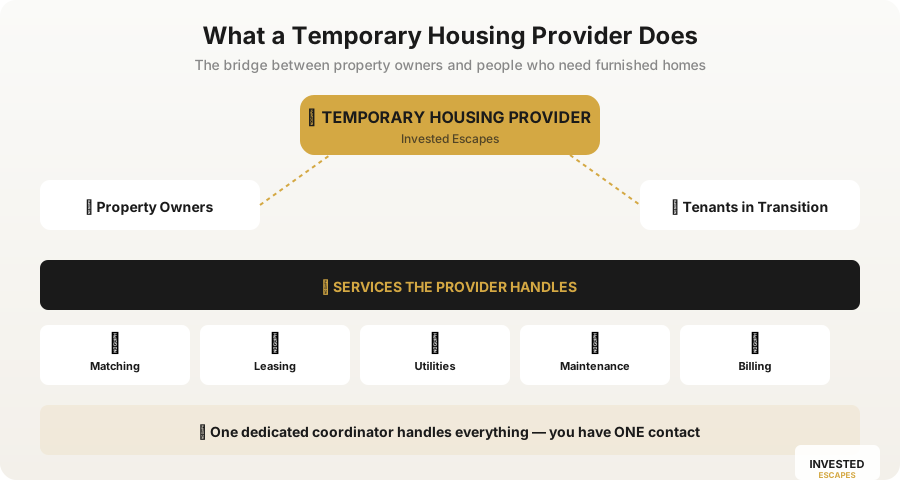
A temporary housing provider is a company that sources, furnishes, and manages temporary housing placements for people in transition. They act as the bridge between property owners (who have furnished homes to rent) and tenants (who need furnished homes for 30 days to 12 months). Temporary housing providers — also called corporate housing companies or relocation housing providers — work with insurance adjusters, corporate relocation coordinators, government agencies, and individuals to match people with the right furnished properties.
A good provider handles everything: property sourcing and matching, lease coordination, utility setup, furnishing and housewares, maintenance during the stay, extensions and modifications, and move-out coordination. You should have one dedicated contact who knows you, knows the property, and is available when you need them.
Why Your Choice of Provider Matters
The difference between a good and bad temporary housing provider isn't just convenience — it affects your daily life, your family's well-being, and your financial situation during a vulnerable time. Here's what's at stake:
- 🏠 Property quality: A good provider has vetted, quality properties. A bad one places you in a property that hasn't been inspected — broken appliances, missing items, cleanliness issues.
- ⚡ Placement speed: A good provider places you in 24-72 hours. A bad one takes weeks, leaving you in a hotel longer than necessary.
- 💬 Communication: A good provider gives you a dedicated coordinator who responds within hours. A bad one routes you through a call center with rotating staff who don't know your case.
- 🔧 Maintenance response: A good provider fixes issues within 24 hours. A bad one takes days or weeks — leaving you without a working stove or hot water.
- 💰 Billing accuracy: A good provider bills your insurance or employer accurately and transparently. A bad one has surprise charges and billing disputes.
- 🔄 Flexibility: A good provider accommodates extensions and changes smoothly. A bad one has rigid policies that create stress when your timeline shifts.
- 🤝 Insurance coordination: A good provider works seamlessly with your adjuster. A bad one creates friction that delays your placement and frustrates your adjuster.
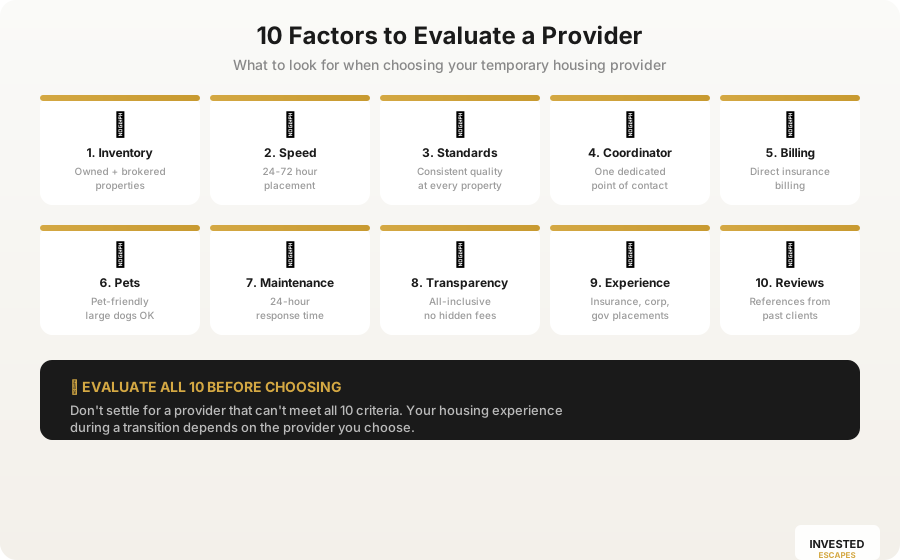
10 Factors to Evaluate When Choosing a Provider
1. Inventory Depth & Coverage 🏠
Does the provider have their own owned/managed inventory, or do they only broker third-party properties? Providers with their own inventory can guarantee quality and respond faster to issues. Providers who only broker may have more variety but less control. The best providers — like Invested Escapes — have their own inventory AND can coordinate with other relocation companies to expand options.
2. Placement Speed ⚡
How quickly can they place you? For insurance displacements, speed matters — you don't want to spend weeks in a hotel. Look for providers who can place within 24-72 hours of request approval. Ask about their average placement time and their process for urgent situations.
3. Property Quality Standards ✨
Are all properties inspected and vetted to consistent standards? Ask about their quality assurance process. Do properties include smart TVs, dedicated workspaces, in-unit laundry, grills, garages, fencing, and backyards? Or do amenities vary wildly from property to property? Consistent standards mean you know what you're getting.
4. Dedicated Coordinator 💬
Do you get one dedicated point of contact who knows you and your property? Or are you routed through a generic call center? A dedicated coordinator is the single most important factor in your experience. They know your case, your property, your adjuster, and your needs — you don't have to re-explain your situation every time you call.
5. Insurance & Corporate Billing 💳
Can they bill your insurance company or employer directly? This is critical for insurance placements — you should NOT have to front the money and wait for reimbursement. Ask if they have experience working with major insurance carriers and if they offer direct billing.
6. Pet-Friendly Options 🐕
Do they have pet-friendly properties — including for large dogs? If you have pets, this is non-negotiable. Ask about their pet-friendly inventory, any pet fees, and whether properties have fenced yards. The best providers welcome pets at no extra charge.
7. Maintenance Response Time 🔧
What's their maintenance response time? If the AC breaks in July or the heat stops in January, how fast do they fix it? Look for providers with 24-hour response guarantees and a network of local maintenance contractors.
8. Transparency in Pricing 💰
Is the monthly rate truly all-inclusive, or are there hidden fees? Ask specifically: Are utilities included? Internet? Is there a cleaning fee? Are there pet fees? Are there any additional charges beyond the monthly rate? A good provider gives you one clear number.
9. Experience with Your Situation 🎯
Do they have experience with your specific situation — insurance displacement, corporate relocation, traveling nurses, government contracts? Different situations have different requirements. A provider experienced with insurance placements knows how to work with adjusters, understands ALE coverage, and can navigate the billing process smoothly.
10. Reputation & Reviews ⭐
What do past clients say? Look for reviews from insurance placements, corporate relocations, and other situations similar to yours. Ask for references. A provider's track record with clients in your situation is the best predictor of your experience.
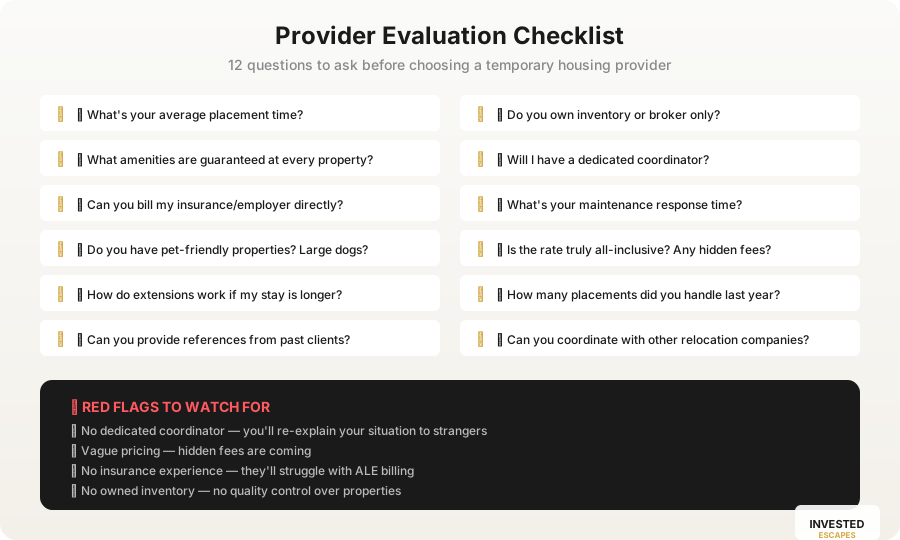
Questions to Ask Before Choosing a Provider
- ⚡ Speed: What's your average placement time from request to move-in?
- 🏠 Inventory: Do you have your own managed properties, or do you broker third-party listings?
- ✨ Standards: What amenities are guaranteed at every property? (Smart TVs? Workspace? In-unit laundry? Grill? Backyard? Garage?)
- 💬 Support: Will I have a dedicated coordinator, or do I call a general line?
- 💳 Billing: Can you bill my insurance company/employer directly?
- 🔧 Maintenance: What's your guaranteed maintenance response time?
- 🐕 Pets: Do you have pet-friendly properties for large dogs? Any pet fees?
- 💰 Pricing: Is the monthly rate truly all-inclusive? Any additional fees?
- 🔄 Extensions: How do extensions work if my stay needs to be longer?
- 📋 Experience: How many insurance/corporate placements did you handle last year?
- ⭐ References: Can you provide references from past clients in my situation?
- 🤝 Coordination: Can you coordinate with other relocation companies if needed for my placement?
Sometimes multiple temporary housing providers may be involved in your placement. Some providers work interchangeably as relocation companies, and two companies may collaborate with your insurance company or employer to find the best option. This is standard and best practice — specific inventory requirements mean some providers have better inventory than others for certain needs. Invested Escapes has its own owned/managed inventory AND can coordinate with other relocation companies to find the RIGHT property for you.
Red Flags to Watch For
- 🚩 No dedicated coordinator: If they can't assign you one person to contact, you'll spend your stay re-explaining your situation to strangers
- 🚩 Vague pricing: If they won't give you a clear all-inclusive monthly rate, there are hidden fees coming
- 🚩 No insurance experience: If they've never worked with insurance adjusters, they'll struggle with ALE billing and coordination
- 🚩 Slow response times: If they take days to respond to your initial inquiry, they'll take days to respond to maintenance issues
- 🚩 No pet-friendly options: If they can't accommodate your pet, they have limited inventory — and they don't understand families
- 🚩 No owned inventory: If they only broker third-party properties, they have no control over quality or maintenance response
- 🚩 Pressure to commit immediately: If they push you to accept a placement without seeing photos or details, they're hiding something
- 🚩 No references: If they can't provide references from past clients, their track record is weak
How Invested Escapes Measures Up
| Criteria | Invested Escapes |
|---|---|
| 🏠 Inventory | Owned/managed inventory + coordination with other relocation companies |
| ⚡ Placement Speed | 24-72 hours from request approval to move-in |
| ✨ Property Standards | Consistent: smart TVs, workspace, in-unit laundry, grill, backyard, garage, fencing |
| 💬 Coordinator | Dedicated housing coordinator for every placement |
| 💳 Billing | Direct billing to insurance companies and employers |
| 🔧 Maintenance | 24-hour response guarantee with local contractor network |
| 🐕 🐕 Pets | Pet-friendly, including large dogs, no daily fees |
| 💰 💰 Pricing | Truly all-inclusive monthly rate — no hidden fees |
| 🔄 Extensions | Month-to-month extensions with notice |
| 📋 Experience | Corporate relocations, insurance placements, government contracts, traveling nurses |
The Bottom Line
Choosing the right temporary housing provider is one of the most important decisions you'll make during a transition. The right provider makes the process smooth, fast, and stress-free — placing you in a quality furnished home within days, handling all logistics, and supporting you throughout your stay. The wrong provider adds stress, delays, and frustration to an already difficult situation. Take the time to evaluate providers using the criteria above, ask the right questions, and don't settle for a provider that can't meet your needs. For more on temporary housing, see our temporary housing guide and our comparison of temporary housing vs Airbnb.
For more comparisons, see our complete temporary housing guide and our corporate housing by owner guide. For insurance-related housing, see our insurance housing guide.
Looking for a Temporary Housing Provider?
Tell us about your situation — relocation, insurance displacement, temporary assignment — and we'll show you why Invested Escapes is the right choice. We typically respond within 24 hours.
Frequently Asked Questions
What is a temporary housing provider?
A temporary housing provider is a company that sources, furnishes, and manages temporary housing placements for people in transition — corporate relocations, insurance displacements, traveling nurses, government contractors, and anyone needing a furnished home for 30 days to 12 months. The provider acts as the bridge between property owners and tenants, handling matching, leasing, utilities, maintenance, and ongoing support.
How do I choose a temporary housing provider?
Evaluate providers on 10 factors: (1) inventory depth and coverage, (2) placement speed, (3) property quality standards, (4) dedicated coordinator, (5) insurance and corporate billing capability, (6) pet-friendly options, (7) maintenance response time, (8) pricing transparency, (9) experience with your specific situation, and (10) reputation and reviews. Ask specific questions about each before committing.
How quickly should a temporary housing provider be able to place me?
A good temporary housing provider should be able to place you in a furnished home within 24-72 hours of your request being approved. For insurance placements, this starts once your adjuster authorizes ALE housing. If a provider says it will take weeks, look elsewhere — you shouldn't be stuck in a hotel longer than necessary.
Can a temporary housing provider bill my insurance company directly?
Yes — a good temporary housing provider offers direct billing to insurance companies and employers. This means you don't have to front the money and wait for reimbursement. If a provider can't bill your insurance directly, it's a red flag that they lack experience with insurance placements. Invested Escapes offers direct insurance billing.
What are the red flags when choosing a temporary housing provider?
Red flags include: no dedicated coordinator (you'll re-explain your situation to strangers), vague pricing (hidden fees incoming), no insurance experience (they'll struggle with ALE billing), slow response times, no pet-friendly options, no owned inventory (no quality control), pressure to commit without seeing photos, and inability to provide references from past clients.
What's the difference between a corporate housing company and a temporary housing provider?
The terms are often used interchangeably. Both source and manage furnished temporary housing. However, "corporate housing company" typically implies a focus on corporate relocations, while "temporary housing provider" encompasses a broader range of situations including insurance displacements, government contracts, and individual placements. Invested Escapes operates as both — serving corporate, insurance, government, and individual clients.
Need Corporate Housing?
Whether you're a property owner looking to earn income or a tenant needing a furnished home, Invested Escapes can help.