Temporary Housing for Fire Victims: What to Do Next
If your home has been damaged by fire, this guide walks you through every step — filing your insurance claim, activating ALE coverage, requesting a furnished home instead of a hotel, and beginning your recovery.
Invested Escapes
Temporary Housing Experts
If you're reading this because your home has been damaged by fire, we want to say first: we're sorry, and we're here to help. A house fire is one of the most traumatic events a family can experience. In the span of hours, you've lost your safe space, your belongings, and your sense of stability. But here's what you need to know right now: if you have homeowners or renters insurance, you have Additional Living Expenses (ALE) coverage that pays for temporary housing while your home is being repaired. You don't have to front the money. You don't have to live in a hotel for months. And you can be in a real, furnished home within 24-72 hours. This guide walks you through exactly what to do next — step by step.
Step 1: Ensure Safety First
Before anything else, make sure you and your family are safe. If you haven't already done so, contact your local fire department to confirm it's safe to approach your property. Do not enter a fire-damaged structure until the fire marshal has cleared it. If anyone needs medical attention, seek it immediately — smoke inhalation and burn injuries can worsen over time.
- 🚨 Don't enter the structure: Wait for fire marshal clearance — structural damage and toxic residues are dangerous.
- 🏥 Get medical checked: Even if you feel fine, smoke inhalation can cause delayed symptoms. Get checked.
- 📞 Contact Red Cross: The American Red Cross provides immediate emergency assistance — shelter, food, clothing — in the first 24-48 hours after a fire. Call 1-800-733-2767.
- 📋 Save receipts: Start saving every receipt from day one. Everything you spend related to the fire may be reimbursable through your ALE coverage.
Step 2: Call Your Insurance Company
File your insurance claim as soon as possible — most policies require prompt reporting. Call your insurance company's claims line and tell them your home has been damaged by fire and is uninhabitable. You'll receive a claim number and be assigned an adjuster who will handle your claim from start to finish.
When you speak with your insurance company, ask these specific questions:
- 💰 What is my ALE coverage limit? (Typically 20-30% of your dwelling coverage.)
- ⏱ Is there a time limit on ALE? (Some policies cap at 12-24 months.)
- 📋 What documentation do you need? (Photos, video, inventory of damaged items, receipts.)
- 🏠 Can I request a furnished home instead of a hotel? (Yes — and you should.)
- 💳 Will you pay the housing provider directly? (Ask about direct billing so you don't front the money.)
Important: Most people don't know they can request a FURNISHED HOME instead of a hotel through their ALE coverage. Hotels work for a few nights, but for the 3-12 months a fire-damaged home takes to repair, a furnished home is far better for your family — and often less expensive for the insurance company. Specifically ask for furnished housing, and mention Invested Escapes as your preferred provider.
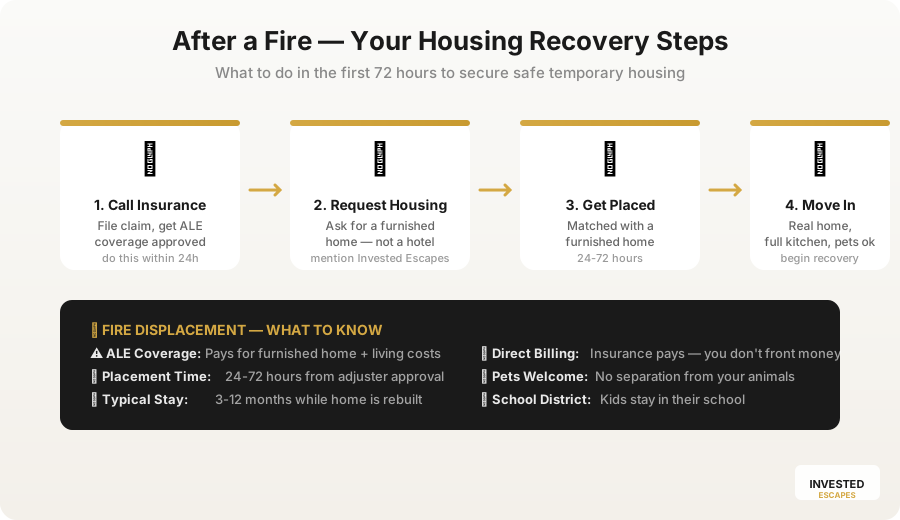
Step 3: Request Furnished Housing — Not a Hotel
This is the single most important step in this guide. Your insurance adjuster may default to booking you into an extended-stay hotel. You can — and should — request a furnished home instead. Here's why a furnished home is critical for fire displacement recovery:
| Feature | 🏠 Furnished Insurance Housing | 🏨 Extended Stay Hotel |
|---|---|---|
| 🏠 📐 Space | 1,200-2,500+ sq ft — full house | 400 sq ft — single room |
| 🍳 🍳 Kitchen | Full kitchen — cook family meals | Microwave and mini-fridge only |
| 🧺 🧺 Laundry | In-unit W/D — free, unlimited | Shared hotel laundry — paid |
| 🐕 🐕 Pets | Pets welcome — no separation | Most hotels don't accept pets |
| 🧠 Recovery | Home environment aids recovery | Hotel fatigue compounds trauma |
| 💰 💰 Cost | $3,000-$6,000/mo — all-inclusive | $3,600-$5,400/mo + restaurant costs |
| 🎒 School | Placed in your school district | Commercial area — not school-zoned |
| 💳 Billing | Direct insurance billing | May require upfront payment + reimbursement |
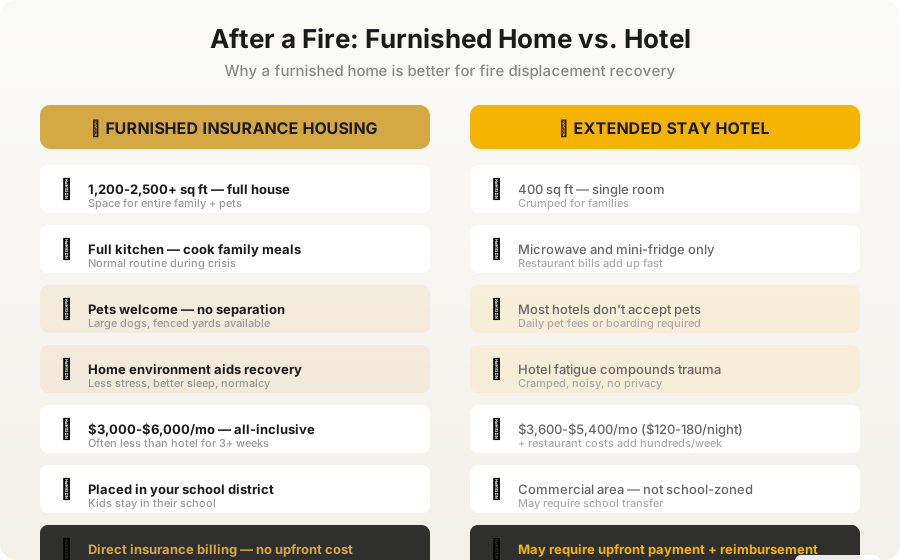
Pro tip: A furnished home is often less expensive for the insurance company than a hotel after the first two weeks. Monthly furnished housing rates run $3,000-$6,000/month, while extended-stay hotels at $120-$180/night cost $3,600-$5,400/month — with a fraction of the space. Insurance companies are generally receptive to furnished housing when you explain the cost savings.
What ALE Covers After a Fire
Additional Living Expenses (ALE) — also called Loss of Use coverage — pays for the additional costs of living away from home when your residence is uninhabitable due to a covered loss. Fire is one of the most common ALE triggers. Here's what's typically covered:
- 🏠 Temporary housing: Furnished home rental while your home is being repaired or rebuilt.
- ⚡ Utilities: Electricity, water, gas, internet at the temporary residence (if not already included in rent).
- 🍽 Additional food costs: Extra meal costs above your normal grocery spending — keep all restaurant and grocery receipts.
- 🧺 Laundry: If no in-unit laundry is available at your temporary housing (another reason to request a furnished home with in-unit W/D).
- 🐕 Pet boarding: If your temporary housing doesn't accept pets — but request a pet-friendly furnished home to avoid this entirely.
- 📦 Storage: Storage costs for belongings salvaged from the fire-damaged home.
- 🚗 Increased commuting costs: Extra mileage from your temporary location to work, school, or medical appointments.
- 🚚 Moving costs: Moving belongings into temporary housing and back home when repairs are complete.
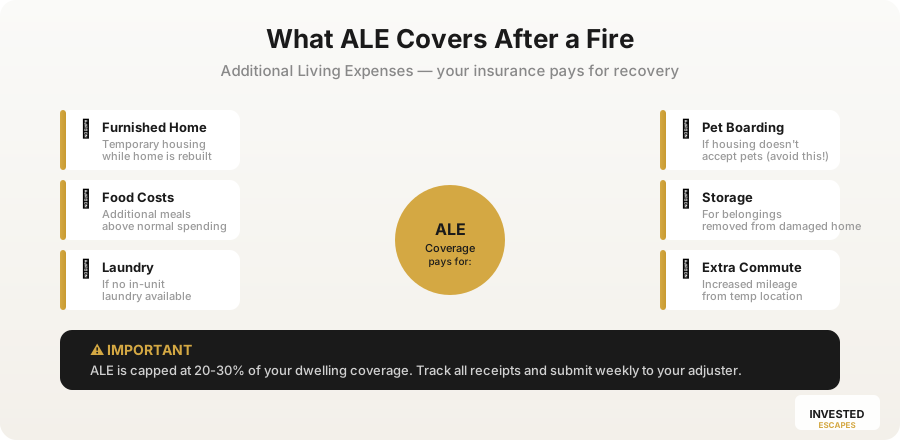
ALE coverage has limits. Most policies cap ALE at 20-30% of your dwelling coverage limit, and some policies impose a time limit (typically 12-24 months). Ask your adjuster for your exact ALE limit and track all expenses carefully. Submit receipts weekly — don't save them all for the end.
Step 4: Work with a Temporary Housing Provider
Your insurance adjuster may refer you to a temporary housing provider, or you can request one by name. Tell your adjuster you'd like to work with Invested Escapes. We'll coordinate directly with your insurance company to place you in a furnished home — here's what happens:
What We Handle
- 🔍 Sourcing and matching: We find available furnished properties near your damaged home (to keep kids in their school district and minimize commute disruption).
- 📋 Insurance coordination: We work directly with your adjuster on placement, budget approval, and direct billing — you don't manage the back-and-forth.
- ⚡ Utilities and setup: Electricity, water, gas, internet, and streaming are active on move-in day.
- 🛋 Full furnishing: Furniture, kitchenware, linens, towels, and basic supplies — everything ready for arrival.
- 🔧 Maintenance: If something breaks during your stay, we coordinate repairs — not your problem.
- 🔄 Extensions: If your home repairs take longer than expected (very common after fires), we accommodate month-to-month extensions.
What You Provide
- 📋 Family needs: Number of bedrooms, pet details (type, breed, size), accessibility requirements, school district preferences.
- 💬 Communication: Stay in touch with your adjuster about the placement and any changes to your repair timeline.
- 🏡 Property care: Treat the temporary home as you would your own — you're a guest in someone's property.
- 📅 Notice: Tell us when you're ready to move back home or need an extension.
Sometimes multiple temporary housing providers may be involved in your placement. Some providers work as relocation companies, and two may coordinate with your insurance company to find the best option for your family's specific needs. This is standard and best practice — different providers have different inventory in different markets. Invested Escapes has our own managed inventory AND can coordinate with other relocation companies to find you the right home.
Step 5: Document Everything
Throughout your displacement, keep meticulous records. These will support both your ALE reimbursement and your overall fire damage claim:
- 📸 Photos and video: Document all fire, smoke, and water damage before any cleanup begins.
- 📋 Inventory of damaged items: List every damaged or destroyed item with approximate value and purchase date.
- 🧾 All receipts: Meals, lodging, mileage, laundry, moving, storage — every expense related to your displacement.
- 📅 Communication log: Keep a log of every conversation with your adjuster — date, time, what was discussed, and any commitments made.
- 📧 Save all emails: Correspondence with your insurance company, housing provider, and contractors.
What to Expect During Your Stay
When you move into your furnished temporary home, you'll find everything ready for a normal life — not a hotel experience, but a real home:
- 📺 Smart TVs: In the living room and bedrooms — log into your own Netflix, Hulu, and Disney+ profiles.
- 💻 Workspace: A dedicated desk and ergonomic chair for remote work or handling insurance paperwork.
- 🍳 Full kitchen: Stove, oven, full-size refrigerator, dishwasher, microwave, cookware, dishes, and utensils — cook real meals.
- 🧺 In-unit laundry: Washer and dryer — free and unlimited. No more hotel laundry rooms.
- 🔥 Grill: Gas or charcoal grill for outdoor cooking — normalcy matters during recovery.
- 🚗 Garage or parking: Dedicated, secure parking — especially important if you're arriving home late from work or appointments.
- 🔒 Fenced yard: Privacy and safety — especially important for pets and children.
- 🌳 Backyard: Outdoor space to decompress, play with kids, and let pets run — crucial for mental health during a stressful time.
- 🐕 Pets with you: Your dog or cat stays with the family — no traumatic separation on top of everything else.
Timeline: What to Expect After a Fire
| Timeline | What Happens |
|---|---|
| 🔥 Day 0 | Fire occurs. Emergency responders secure the scene. Red Cross provides immediate assistance. |
| 📞 Day 1-2 | File insurance claim. Adjuster assigned. Request ALE housing and furnished home. |
| 🏠 Day 2-3 | Temporary housing provider matches you with a furnished home. Insurance approves placement. |
| 🧳 Day 3-5 | Move into furnished home. Everything is ready — just bring personal belongings. |
| 🔍 Week 1-4 | Adjuster inspects damage. Repair scope assessed. Contractors bid on repairs. |
| 🔨 Month 1-12 | Home is repaired or rebuilt. You live comfortably in furnished housing during construction. |
| 🏡 Month 3-12 | Repairs complete. Final inspection. Move back home. |
If you've been displaced by a fire, contact your insurance adjuster and request Invested Escapes as your temporary housing provider. We'll coordinate directly with your insurance company to get you into a furnished home — often within 24-72 hours of approval. You don't have to live in a hotel for months. You don't have to separate from your pets. You can have a real home while you rebuild.
Learn more about how insurance housing and ALE coverage work in our complete guide.
Insurance Housing Guide →Need to understand your renters insurance coverage? See <a href="/blog/renters-insurance-guide">our <a href="/blog/renters-insurance-guide">renters insurance guide</a></a>.
Renters Insurance Guide →For more help, see our complete guide to insurance housing and ALE and our renters insurance guide. If you need temporary housing during renovations, see our renovation housing guide.
Displaced by a Fire?
If your home has been damaged by fire and you have insurance, tell us about your situation. We'll coordinate with your adjuster to place you in a furnished home — often within 24-72 hours. You don't have to live in a hotel while your home is rebuilt.
Frequently Asked Questions
Does insurance pay for temporary housing after a fire?
Yes. If your homeowners or renters insurance policy includes Additional Living Expenses (ALE) coverage — and most do — your insurance company will pay for temporary housing while your fire-damaged home is being repaired. ALE covers furnished homes, hotels, additional food costs, laundry, pet boarding, storage, and increased commuting costs. You can request a furnished home instead of a hotel — which is usually better for families and often less expensive for the insurance company.
How long can I stay in temporary housing after a fire?
Your ALE coverage pays for temporary housing until your home is repaired and habitable again — or until your ALE limit is reached, whichever comes first. Most policies cap ALE at 20-30% of your dwelling coverage limit, with a time limit of 12-24 months. Fire damage repairs typically take 3-12 months depending on the extent of damage. Your housing provider can accommodate month-to-month extensions if repairs take longer than expected.
Can I choose a furnished home instead of a hotel after a fire?
Yes. Through your ALE coverage, you can specifically request a furnished home instead of a hotel. Insurance companies are generally receptive because furnished homes are often less expensive than hotels on a monthly basis. A furnished home gives you a full kitchen, private bedrooms, in-unit laundry, a backyard, and pet-friendly options — far better than a hotel room for a multi-month stay. Ask your adjuster to work with a temporary housing provider like Invested Escapes.
What if I have pets and my home was damaged by fire?
Request a pet-friendly furnished home through your ALE coverage. Many temporary housing properties welcome pets — including large dogs that hotels won't accept. If you request Invested Escapes as your housing provider, we can match you with pet-friendly properties that have fenced yards. Keeping your pets with you during recovery is important for your family's emotional wellbeing — avoid pet boarding if possible.
How quickly can I get placed in temporary housing after a fire?
Once your insurance adjuster authorizes ALE coverage, a temporary housing provider like Invested Escapes can typically place you in a furnished home within 24-72 hours. The more information you provide upfront — number of bedrooms, pet details, school district preferences, accessibility needs — the faster we can match you with the right property.
Do I have to pay upfront for temporary housing after a fire?
Not necessarily. Many temporary housing providers, including Invested Escapes, offer direct insurance billing — meaning we bill your insurance company directly and you don't have to front the money. When requesting housing, ask your adjuster about direct billing arrangements. If you do pay out of pocket, keep all receipts for ALE reimbursement.
Need Corporate Housing?
Whether you're a property owner looking to earn income or a tenant needing a furnished home, Invested Escapes can help.