What Does Renters Insurance Cover? Complete Breakdown of Coverage, Limits & ALE
A complete breakdown of what renters insurance covers — personal property, liability, and additional living expenses (ALE). Learn what's included, what's excluded, and how much coverage you actually need.
Invested Escapes
Temporary Housing Experts
If you rent your home, one question matters more than any other: what does renters insurance actually cover? Most renters either don't have a policy or have one they've never read. The result is that millions of renters are paying for coverage they don't understand — or worse, going without it entirely. According to the Insurance Information Institute, only about 55% of renters carry insurance, compared to 95% of homeowners. This guide gives you a complete, no-jargon breakdown of exactly what renters insurance covers, what it doesn't, how much each part pays out, and how the ALE (Additional Living Expenses) component can place you in a furnished home if you're ever displaced from your rental.
The Three Pillars of Renters Insurance Coverage
A standard renters insurance policy — also called an HO-4 policy — includes three distinct coverage types bundled into one affordable monthly premium. Understanding each pillar helps you know exactly what you're paying for and what to expect if you ever need to file a claim.
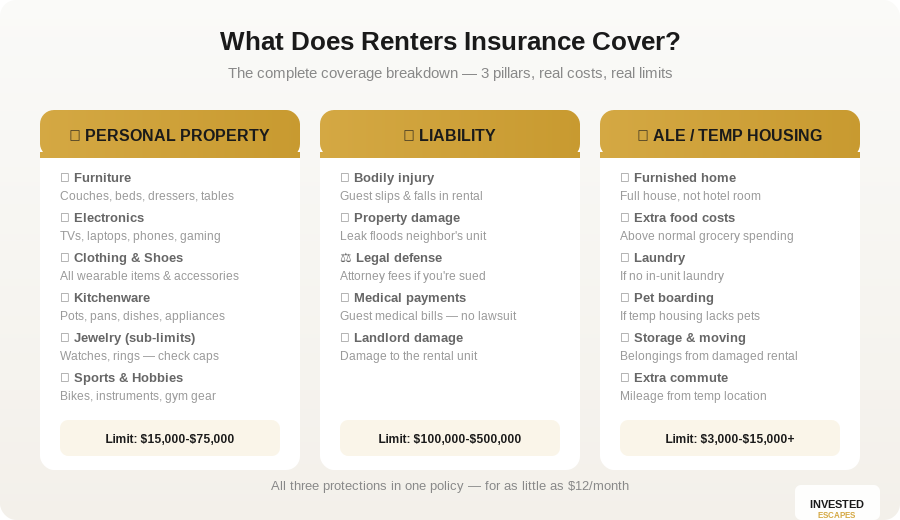
Pillar 1: Personal Property Coverage 📦
Personal property coverage is the foundation of renters insurance. It pays to replace your belongings if they're damaged, destroyed, or stolen — whether inside your rental, in your car, or anywhere else. If a fire destroys your apartment, a pipe bursts and ruins your furniture, or someone breaks in and steals your laptop, personal property coverage pays to replace those items minus your deductible.
Most policies offer replacement cost value (RCV) or actual cash value (ACV). RCV pays what it costs to buy a new equivalent item today. ACV pays what your item was worth at the time of loss (depreciated). RCV is better — and usually costs only slightly more per month.
- 🛋 Furniture: Couches, beds, dressers, tables, desks, chairs
- 🖥 Electronics: TVs, laptops, computers, gaming consoles, phones, tablets
- 👕 Clothing: All wearable items, shoes, coats, accessories
- 🍳 Kitchenware: Pots, pans, dishes, small appliances, silverware
- 💍 Jewelry & valuables: Watches, rings, collectibles (sub-limits apply — typically $1,500-$2,500 per item)
- 📚 Books & media: Books, records, CDs, collectibles
- 🏋️ Sports equipment: Bikes, gym gear, camping equipment, kayaks
- 🎸 Musical instruments: Guitars, keyboards, audio equipment, microphones
Pro tip: High-value items like engagement rings, expensive watches, or professional camera equipment may exceed standard sub-limits. Add a **scheduled personal property endorsement** (also called a "rider") to cover these items at their full value — usually for just a few extra dollars per month.
Pillar 2: Liability Coverage 🛡️
Liability coverage protects you financially if you're responsible for someone else's injury or property damage. If a guest slips in your kitchen and breaks their wrist, if your bathtub overflows and floods the apartment below, or if your dog bites someone — liability coverage pays for medical bills, repairs, and legal defense up to your policy limit.
- 🩹 Bodily injury: If a guest slips and falls in your rental
- 💧 Property damage: If you accidentally damage a neighbor's property (water leak, fire)
- ⚖️ Legal defense: Attorney fees and court costs if you're sued
- 💊 Medical payments: Small medical bills for guests injured on your premises — no lawsuit required
- 🏠 Landlord's property: If you cause damage to the rental unit itself
Pillar 3: Additional Living Expenses (ALE) 🏠
ALE is the coverage that matters most if you're ever displaced from your rental. It pays for temporary housing when your rental becomes uninhabitable due to a covered peril — fire, water damage, smoke damage, or other covered events. ALE covers a furnished home, hotel, or other temporary lodging plus additional living expenses like food, laundry, and commuting. For a complete overview of how ALE works, see our guide to how ALE insurance works.
- 🏠 Temporary housing: Furnished home or hotel while your rental is repaired
- 🍽 Additional food costs: Extra meal costs above your normal grocery spending
- 🧺 Laundry: If no in-unit laundry at your temporary location
- 🐕 Pet boarding: If temporary housing doesn't accept pets — request a pet-friendly furnished home instead
- 📦 Storage: For belongings removed from damaged rental
- 🚗 Increased commuting costs: Extra mileage from your temporary location
- 🚚 Moving costs: Moving belongings to temporary housing and back
Most renters don't know they can request a FURNISHED HOME instead of a hotel through their ALE coverage. Hotels work for a few nights, but for weeks or months of displacement, a furnished home is better for your family AND often less expensive for the insurance company. Ask your adjuster for furnished housing — and request Invested Escapes by name.
What Perils Does Renters Insurance Cover?
Renters insurance doesn't cover everything — it covers specific named perils (also called covered losses). A peril is the event that causes the damage. Your policy lists which perils are covered, and anything not on the list is excluded. Here's what's covered — and what's not:
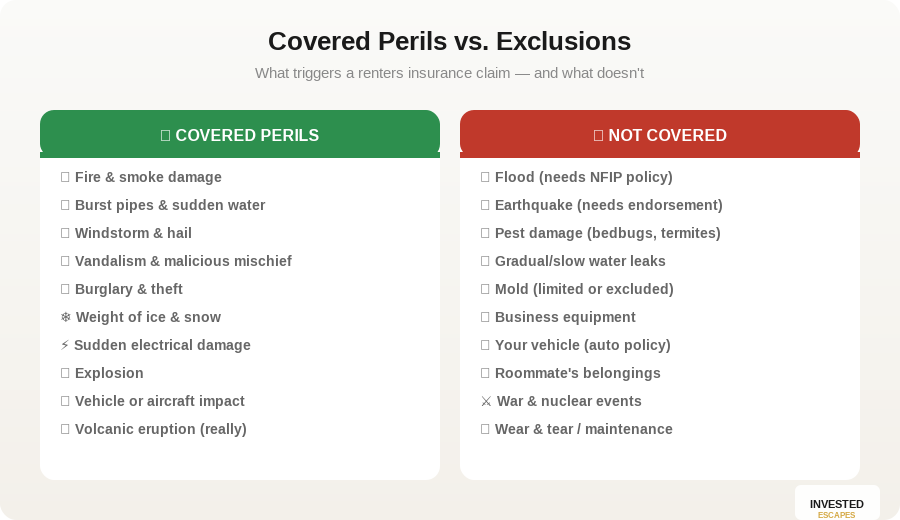
Covered Perils ✅
- 🔥 Fire and smoke: The most common and costly claim — covers damage from fire, smoke, and firefighting efforts
- 💧 Burst pipes and sudden water: Sudden or accidental discharge from plumbing, appliances, or HVAC
- 🌪 Windstorm and hail: Damage from severe storms, tornadoes, and high winds
- 🔨 Vandalism and malicious mischief: Intentional damage to your property by others
- 👜 Burglary and theft: Stolen belongings from your rental or away from home (up to policy limits)
- ❄️ Weight of ice and snow: Roof or structural damage from accumulated snow or ice
- ⚡ Sudden electrical damage: Power surges and sudden electrical shorts that damage electronics
- 💥 Explosion: Damage from gas explosions or other accidental explosions
- 🚗 Vehicle or aircraft impact: If a car crashes into your rental (it happens more than you'd think)
NOT Covered ❌
- 🌊 Flood damage: Requires separate flood insurance through NFIP or a private insurer — standard renters insurance never covers flooding
- 🌍 Earthquakes: Requires a separate earthquake endorsement or standalone policy
- 🐛 Pest damage: Bedbugs, termites, rodents, and other infestations are considered a maintenance issue
- 💧 Gradual water damage: Slow leaks that develop over time are excluded — only sudden and accidental water events are covered
- 🦠 Mold: Often limited or excluded entirely — some policies offer limited mold coverage with an endorsement
- 💼 Business equipment: Home business inventory needs a separate business policy or endorsement
- 🚗 Your vehicle: Auto insurance covers your car, not renters insurance — even if parked in the rental's garage
- 👤 Roommate's belongings: Each renter needs their own policy — your coverage doesn't extend to a roommate
If you live in a flood-prone area or an earthquake zone, standard renters insurance won't protect you. You need separate policies for both. Talk to your insurance agent about NFIP flood insurance and earthquake endorsements — they're often surprisingly affordable.
How Much Does Renters Insurance Cost?
Renters insurance is one of the most affordable insurance products available. The national average is about $15-25 per month — less than the cost of a single streaming subscription. Your actual cost depends on your location, the amount of personal property coverage you choose, your liability limit, your deductible, and whether you add endorsements for high-value items.
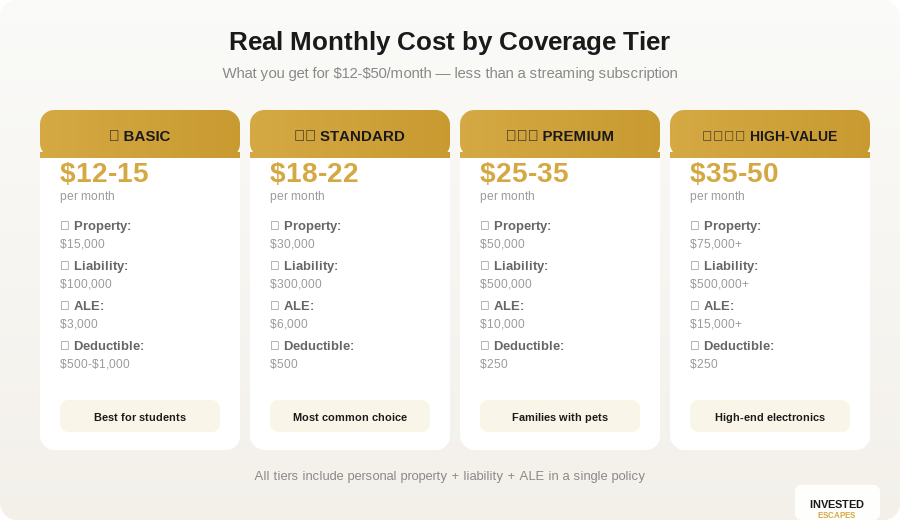
| Coverage Tier | Property Limit | Liability Limit | ALE Limit | Monthly Cost |
|---|---|---|---|---|
| 💰 Basic | $15,000 | $100,000 | $3,000 | $12-15/mo |
| 💰💰 Standard | $30,000 | $300,000 | $6,000 | $18-22/mo |
| 💰💰💰 Premium | $50,000 | $500,000 | $10,000 | $25-35/mo |
| 💰💰💰💰 High-Value | $75,000+ | $500,000+ | $15,000+ | $35-50/mo |
For less than the cost of one streaming subscription, you get $30,000+ in property coverage, $300,000 in liability protection, and ALE coverage that pays for a furnished home if you're displaced. It's one of the best values in all of insurance.
How Much Coverage Do You Need?
To figure out the right amount of personal property coverage, do a simple home inventory. Walk through each room and estimate what it would cost to replace everything at today's prices. Most renters are shocked to discover they own $25,000-$40,000 in belongings — far more than they expected.
- 🛋 Living room: Couch, TV, entertainment center, coffee table, bookshelf, decor — $3,000-8,000
- 🛏 Bedroom: Bed frame, mattress, dresser, nightstand, linens, closet of clothes — $2,000-6,000
- 🍳 Kitchen: Pots, pans, dishes, appliances, silverware, pantry items — $1,000-3,000
- 🖥 Electronics: Laptop, phone, tablet, gaming console, headphones, smart speaker — $2,000-5,000
- 👕 Clothing: Everything in your closet and dresser — $2,000-5,000
- 🏋️ Sports & hobbies: Bike, gym membership equipment, instruments, camping gear — $500-3,000
Add it all up and round up to the nearest $5,000. That's your target personal property limit. For liability, $300,000 is the standard recommendation — it costs only a few dollars more per month than $100,000 and provides significantly more protection. For ALE, check whether your policy's ALE limit is 20-30% of your personal property limit — if it seems low, ask about increasing it.
Does Renters Insurance Cover Temporary Housing?
Yes — and this is where Invested Escapes comes in. If your rental becomes uninhabitable due to a covered peril (fire, water damage, smoke damage), your ALE coverage pays for temporary housing. You can — and should — request a furnished home instead of a hotel, especially if you have children, pets, or expect to be displaced for more than two weeks. For a deeper guide on temporary housing options, see our temporary housing guide.
- 🏠 Full furnished home: Full kitchen, private bedrooms, in-unit laundry, backyard, grill, garage
- 📺 Smart TVs & workspaces: Log into your own streaming profiles, dedicated desk for remote work
- 🌳 Backyard & outdoor space: Space for kids and pets — a real neighborhood, not a hotel corridor
- 🐕 Pet-friendly: Most Invested Escapes properties welcome pets — no separation from your dog or cat
- ⚡ 24-72 hour placement: We place you within 24-72 hours of your adjuster's approval
- 💳 Direct insurance billing: We bill your insurance company directly — you don't front the money
If you've been displaced from your rental, contact your insurance adjuster and request Invested Escapes as your temporary housing provider. We'll coordinate with your insurance company to get you into a furnished home — often within 24-72 hours of approval.
Common Myths About What Renters Insurance Covers
"My landlord's insurance covers my stuff" ❌
False. Your landlord's insurance covers the building structure — the roof, walls, plumbing, and electrical. It does NOT cover your personal belongings. If a fire destroys your apartment, your landlord's insurance pays to rebuild the building. Your renters insurance pays to replace your furniture, electronics, and clothes.
"Renters insurance only covers theft" ❌
False. Theft is just one of many covered perils. Renters insurance also covers fire, smoke, water damage from burst pipes, windstorm, vandalism, and more. It also includes liability protection and ALE for temporary housing — theft is a small part of what the policy covers.
"I don't own enough to need coverage" ❌
False. Most renters own $20,000-$40,000 in belongings. A quick inventory — clothes, electronics, furniture, kitchen items — shows how quickly the total adds up. Replacing all of it out of pocket would be financially devastating for most people.
"ALE only covers cheap hotels" ❌
False. ALE covers comparable living arrangements — meaning if you rent a 2-bedroom apartment, your ALE should cover a furnished 2-bedroom home or comparable temporary housing. You can specifically request a furnished home through a provider like Invested Escapes, which is often better for families AND less expensive for the insurance company than extended-stay hotels.
For more help, see our complete renters insurance guide and our insurance housing guide. For a full overview, see our temporary housing guide.
Displaced from Your Rental?
If your rental is uninhabitable and you have renters insurance, tell us about your situation. We'll coordinate with your adjuster to place you in a furnished home — often within 24-72 hours.
Frequently Asked Questions
What does renters insurance cover?
Renters insurance covers three main areas: (1) Personal property — your furniture, electronics, clothing, and other belongings if they're damaged, destroyed, or stolen by a covered peril like fire, theft, or water damage; (2) Liability — if a guest is injured in your rental or you cause damage to a neighbor's property; and (3) Additional Living Expenses (ALE) — temporary housing and extra living costs if your rental becomes uninhabitable due to a covered loss.
Does renters insurance cover theft outside the home?
Yes. Personal property coverage in a standard renters insurance policy covers your belongings anywhere in the world — not just inside your rental. If your laptop is stolen from your car, your bike is taken from a bike rack, or your luggage is stolen while traveling, your renters insurance will pay to replace those items (minus your deductible), subject to your policy limits.
What does renters insurance NOT cover?
Standard renters insurance does not cover: flood damage (requires separate NFIP flood insurance), earthquake damage (requires an endorsement), pest damage (bedbugs, termites), gradual water leaks, mold (often limited or excluded), business equipment, your vehicle, or a roommate's belongings. Each of these requires separate coverage or a policy endorsement.
How much renters insurance do I need?
Do a home inventory: walk through each room and estimate the replacement cost of everything you own. Most renters own $20,000-$40,000 in belongings. Choose a personal property limit that covers your total, a liability limit of at least $300,000, and check that your ALE limit is 20-30% of your property coverage. A standard policy with $30,000 property and $300,000 liability costs about $18-22/month.
Does renters insurance pay for a furnished home if I'm displaced?
Yes. Through ALE coverage, your renters insurance pays for temporary housing if your rental becomes uninhabitable. You can request a furnished home instead of a hotel — especially for displacements lasting more than two weeks. A furnished home gives you a full kitchen, private bedrooms, in-unit laundry, and a real neighborhood. Ask your adjuster to work with a temporary housing provider like Invested Escapes, who can place you within 24-72 hours and bill the insurance company directly.
Is renters insurance worth it if I don't own expensive things?
Yes. Even if your belongings are modest, the liability coverage alone is worth the $15-25/month cost. If a guest is injured in your rental or you accidentally flood a neighbor's apartment, you could face tens of thousands in medical bills or repairs. Renters insurance covers those costs plus your legal defense — and the ALE coverage pays for temporary housing if you're ever displaced.
Need Corporate Housing?
Whether you're a property owner looking to earn income or a tenant needing a furnished home, Invested Escapes can help.